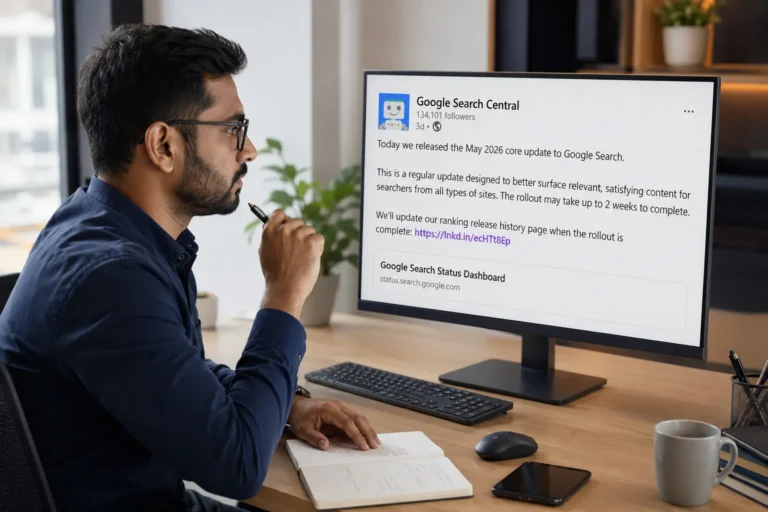

Google May 2026 Core Update Completed
The Google May 2026 Core Update is complete. Google started the rollout on May 21, 2026, and completed it on June 2, 2026, according to the official Google Search Status Dashboard. It was a Broad Core Update, not a penalty. It changed how Google’s core ranking systems assess relevance, helpfulness, trust, and user satisfaction across search results.
Table of Contents
For Indian startup founders, digital marketing professionals, and business owners, the right response is not panic editing. First, check whether your traffic drop matches the rollout dates. Then compare Google Search Console data from after the update with the week before May 21, 2026. Google recommends waiting at least one full week after a core update completes before serious analysis, as explained in its official guide to Google Search core updates.
Google May 2026 Core Update timeline and confirmed facts
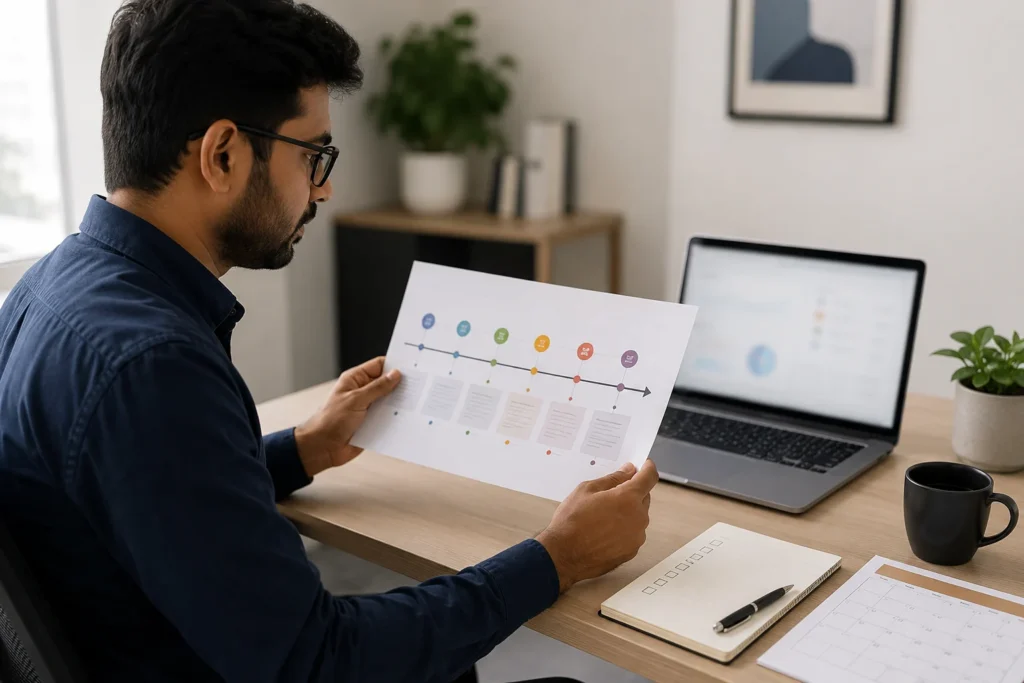
The Google May 2026 Core Update was the second confirmed core update of 2026 and took nearly 12 days to finish.
|
Update Detail |
Confirmed Information |
What It Means for Businesses |
|---|---|---|
|
Update name |
Google May 2026 Core Update Completed |
The rollout is over, so businesses can now review ranking impact with more confidence. |
|
Start date |
May 21, 2026 |
Ranking movement from this date may be connected to the core update. |
|
Completion date |
June 2, 2026 |
Wait at least one full week after this date before making major SEO decisions. |
|
Update type |
Broad Core Update |
It was not a penalty. It refreshed how Google evaluates content quality and relevance. |
|
Scope |
Global Google Search Rankings |
Indian websites, local businesses, startups, and service brands may all see ranking changes. |
|
Main impact |
Ranking and visibility recalibration |
Some pages may gain visibility, while others may drop if competitors provide better answers. |
Google’s ranking incident history also shows that the May update followed the March 2026 core update, March 2026 spam update, and February 2026 Discover update. That makes 2026 a highly active year for Google Search Ranking Update activity.
If you are new to search visibility, Digirank’s guide on what SEO is can help you understand the basics before reviewing your ranking data.
What changed in Google Core Update 2026
This Google Core Update 2026 likely refined how Google compares content quality, search intent, authority, and satisfaction across similar pages.
A Broad Core Update does not usually target one site, one industry, or one SEO tactic. Google explains that most sites may not even notice a core update, but sites that see changes should review top pages and queries instead of assuming a penalty.
What this really means is simple. If another page answers the same query with better depth, clearer proof, fresher context, and stronger trust signals, Google may now rank that page higher.
This depends on the query. A service page may drop because a competitor explains pricing, locations, proof, and process better. A blog may drop because the answer feels generic. A local page may lose visibility if it lacks city-specific signals, reviews, or useful business details.
Why Google Search Rankings dropped after the update
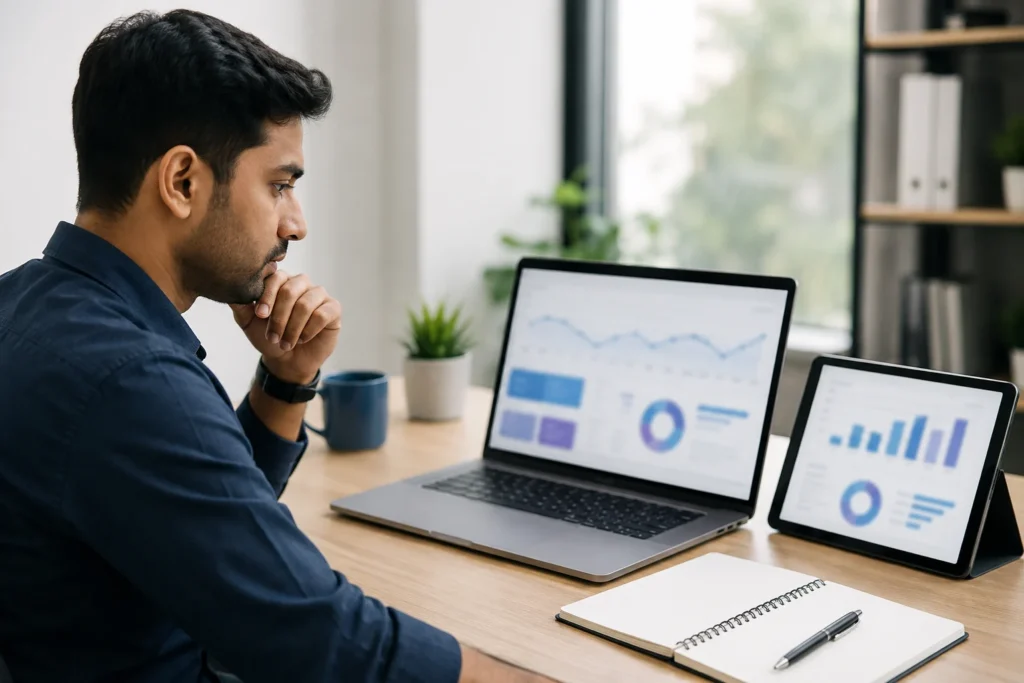
A ranking drop usually means Google now sees another result as more useful for the same search intent.
Do not assume your website was punished. This Google Algorithm Update is a broad ranking recalibration. Search Engine Land also reported that the update caused strong ranking volatility during the rollout, which means fluctuations were expected across many sites.
Start with Google Search Console. Compare:
- Pages that lost impressions
- Queries that lost average position
- Pages that lost clicks but kept impressions
- Keywords that moved from page one to page two
- Blog pages versus service pages
- Branded versus non-branded search traffic
- Desktop versus mobile performance
For a practical workflow, read Digirank’s guide on how to use Google Search Console. It will help you check performance data without guessing.
How Indian businesses should diagnose the impact
Indian businesses should judge this update by qualified leads, enquiries, and commercial visibility, not only total traffic.
A business may lose traffic from low-value informational blogs but keep high-intent leads from service pages. That is not always a serious problem. But if your main money keywords dropped, you need a structured audit.
Check these questions:
- Did your service pages lose rankings?
- Did your location pages lose visibility?
- Did your competitors update content recently?
- Did AI Overviews reduce clicks on simple informational queries?
- Did old blogs lose traffic to fresher and clearer pages?
- Did weak internal linking make important pages harder to discover?
If your business depends on local leads, connect this review with local SEO and Google Business Profile optimization. Local relevance, reviews, service clarity, and Google Business Profile strength can all influence visibility.
Recovery plan after the Google Algorithm Update

The best recovery plan is to improve high-value pages that lost visibility, not rewrite the whole website overnight.
Google’s guidance on creating helpful, reliable, people-first content says ranking systems aim to reward content made for people, not content created mainly to manipulate rankings.
Use this recovery checklist:
- Rewrite weak introductions with a direct answer.
- Add original examples, screenshots, case insights, or Indian market context.
- Remove repeated paragraphs across similar pages.
- Add clear author, business, or expert review signals.
- Improve internal links from strong pages to important pages.
- Update outdated facts, tools, screenshots, and dates.
- Add schema only where it truly matches the page.
- Improve Core Web Vitals and mobile experience.
For deeper improvement, use Digirank’s guides on what an SEO audit is, technical SEO, and schema markup.
What not to do after a Broad Core Update

The biggest mistake after a Broad Core Update is making emotional changes before understanding the data. Ranking drops can feel urgent, but quick edits without analysis can make recovery harder.
Do not delete pages only because traffic dropped for a few days, and do not stuff the primary keyword into every heading. Also avoid buying poor-quality backlinks, replacing weak content with mass AI content, or changing URLs without a clear SEO reason.
Google’s SEO Starter Guide still points site owners toward useful content, clear structure, crawlable pages, and good user experience. These basics matter even more after a Google Algorithm Update because Google is reassessing quality and relevance across search results.
The safer approach is measured improvement based on real data from tools like Google Search Console and analytics platforms. Fix what users can clearly feel, such as weak answers, slow pages, unclear navigation, missing proof, thin sections, and poor service value.
Google May 2026 Core Update and AI search visibility

AI search makes original, useful, well-structured content more important for both Google Search Rankings and AI Overviews.
Google’s official generative AI optimization guide says SEO remains relevant because AI Overviews and AI Mode are rooted in Google’s core Search ranking and quality systems.
That means AEO and GEO are not separate tricks. They are extensions of good SEO. Your content should answer real questions clearly, use simple language, show real experience, and give Google enough context to understand your expertise.
For deeper reading, explore Digirank’s guides on Answer Engine Optimization, Generative Engine Optimization, and AI Overview optimization.
Digirank Brand Take
The Google May 2026 Core Update rewards websites that act less like content factories and more like trusted advisors.
For Indian businesses, the winning strategy is not publishing more blogs blindly. It is building a stronger search system. Your service pages must convert. Your blogs must answer buyer questions. Your internal links must guide users naturally. Your technical SEO must help Google crawl and understand your website. Your content must show proof, not generic advice.
At Digirank, we would not treat a ranking drop as one SEO problem. We would split it into four checks: content quality, search intent match, technical accessibility, and conversion value. That gives businesses a clear recovery path instead of random edits.
FAQs on Google May 2026 Core Update
The Google May 2026 Core Update has created many questions for Indian businesses, SEO teams, and website owners. These FAQs answer the most common concerns about ranking drops, recovery timelines, Google Algorithm Update impact, and how to protect Google Search Rankings after a Broad Core Update.
1. What is the Google May 2026 Core Update?
The Google May 2026 Core Update is a broad update to Google’s ranking systems. It started on May 21, 2026, and completed on June 2, 2026.
2. Is the Google May 2026 Core Update a penalty?
No. A Broad Core Update is not a manual penalty. It means Google has recalibrated how it ranks content across search results.
3. Why did my Google Search Rankings drop after this update?
Your Google Search Rankings may have dropped because Google now finds competing pages more helpful, relevant, fresh, or trustworthy for the same search queries.
4. How long does recovery take after Google Core Update 2026?
Recovery after a Google Core Update 2026 can take weeks or months. It depends on the quality of your improvements and how quickly Google recrawls and reassesses your pages.
5. Should I update all blogs after this Google Algorithm Update?
No. After a Google Algorithm Update, update only pages that lost meaningful visibility and still matter to your business. Focus on usefulness, freshness, proof, and search intent.
6. Does the Broad Core Update target AI-generated content?
Google has not said that this Broad Core Update specifically targets AI content. The safer rule is to publish useful, accurate, original, and reviewed content.
7. How can Indian businesses protect Google Search Rankings?
Indian businesses can protect Google Search Rankings by improving service pages, local SEO, mobile speed, proof, internal links, and content that answers buyer questions clearly.
8. What should I check first after a Google Search Ranking Update?
After a Google Search Ranking Update, check Google Search Console first. Compare top pages, queries, impressions, clicks, and average positions before and after the update rollout.
Conclusion
The Google May 2026 Core Update is an important reminder that SEO is not about quick fixes. It is about building useful content, strong technical foundations, clear internal linking, and trustworthy service pages that answer real customer questions. Now that the rollout is over, Indian businesses should review their Google Search Console data, identify pages that lost meaningful visibility, and improve them with better answers, stronger proof, and clearer user intent. Businesses that focus on quality, relevance, and measurable conversions will be in a better position to protect rankings and grow organic leads after this update.