
June 2026 Spam Update: Crucial SEO Fixes
The June 2026 spam update is Google’s latest confirmed search ranking update aimed at reducing spammy, manipulative, and low-value content from search results. It started rolling out on June 24, 2026, applies globally, and affects all languages, including English and Indian-language search results.
Table of Contents
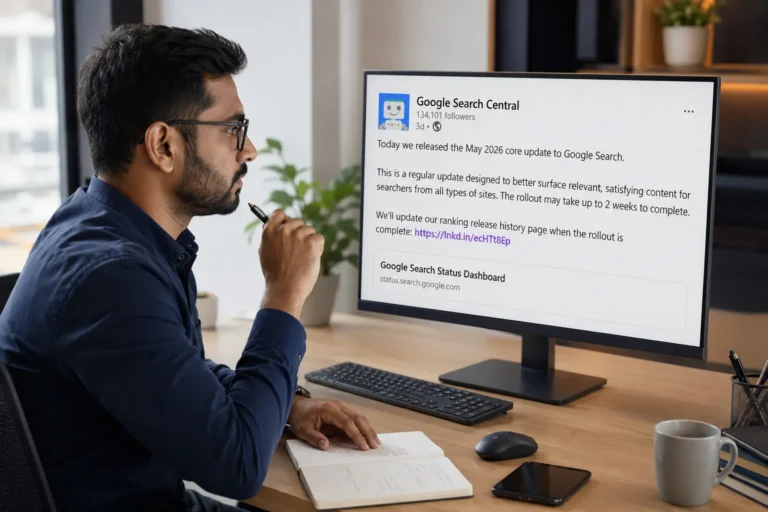
Google confirmed the rollout through the Google Search Status Dashboard, which makes this an official search update, not an industry rumour. That is why businesses should monitor real data before making major SEO changes.
This Google seo update does not mean every website will lose traffic. Clean websites with useful content, strong technical SEO, and real business trust signals may even gain visibility if weaker competitors drop.
What the June 2026 Spam Update Means for SEO Ranking
The June 2026 spam update improves Google’s ability to detect search spam, not simply to reshuffle all good websites.
A spam update is different from a broad core update. A core update reviews overall quality and relevance. A spam update focuses more directly on websites that try to manipulate Seo ranking through shortcuts.
In simple terms, Google wants to reduce pages that rank because of tricks, not value. That includes content created only to capture keywords, pages copied from competitors, fake authority pages, and technical tricks that mislead users.
For a deeper comparison, read Digirank’s guide on Google core update vs spam update. It helps you understand whether your ranking issue is a quality problem, a spam problem, or a technical SEO problem.
Why This Google Latest Update Matters for Indian Businesses
Indian businesses depend heavily on Google Search for leads, local discovery, product research, and service enquiries.
If your website ranks for local service keywords, startup solutions, ecommerce categories, education queries, finance topics, or healthcare-related searches, even a small Seo ranking update can affect calls, form submissions, and revenue.
This update matters more if your website has:
- Many similar city pages with little unique value
- AI-generated blogs published without expert review
- Old pages rewritten only to chase trending keywords
- Guest posts or backlinks from poor-quality sites
- Aggressive popups, redirects, or ad-heavy layouts
- Service pages that make claims without proof
- FAQ sections written only for rankings, not users
If your site already follows helpful content, strong technical SEO, and clear brand trust signals, this Google latest update is more of a reminder than a threat.
How to Check If Your Website Was Affected

Do not judge impact from one day of ranking movement. Wait for clearer data and compare patterns properly.
Start with Google Search Console. Check clicks, impressions, average position, affected pages, and affected queries. If the drop started around June 24 or later, the June 2026 spam update could be one possible reason.
Use this simple diagnosis flow:
|
What You See |
Likely Meaning |
What to Check |
|---|---|---|
|
Site-wide drop |
Spam, technical, or major quality issue |
Search Console, indexing, manual actions |
|
Few pages dropped |
Page-level quality or intent mismatch |
Content depth and competitor pages |
|
Impressions stable, clicks down |
SERP layout or CTR issue |
Titles, snippets, AI Overviews |
|
Only local pages dropped |
Thin local SEO issue |
Location page uniqueness |
|
Sudden deindexing |
Serious technical or policy issue |
Manual actions and indexing |
Also review your setup using Google Search Console basics and run a complete SEO audit before making major changes.
Common Spam Risks This SEO Ranking Update May Expose

Google’s official Search spam policies cover practices such as scaled content abuse, cloaking, doorway pages, sneaky redirects, link spam, and scraped content. Indian businesses should review these areas carefully before blaming the update on normal ranking fluctuation.
Here’s the thing: Google does not need every page to be bad. A large cluster of low-value pages can reduce trust across sections of a website. That is why business websites should review both content quality and technical behavior.
Check for these issues:
- Scaled content abuse
Publishing hundreds of pages with repeated structure, shallow advice, and no original insight can look risky. AI content is not automatically spam, but mass AI content without real value is a problem.
- Keyword stuffing
Repeating June 2026 spam update, Google seo update, Seo ranking, or location keywords unnaturally can hurt readability and trust.
- Doorway pages
Pages made only to rank for cities, services, or variants without unique information can be flagged as low value.
- Scraped or rewritten content
Copying competitor content and changing a few words does not build authority.
- Misleading redirects or navigation tricks
Google has also called out deceptive browser navigation practices such as back-button hijacking. Any script, ad network, or third-party code that traps users should be removed.
- Weak E-E-A-T signals
If your website gives advice on money, law, health, or major business decisions, show real expertise, author details, sources, and business credibility. Digirank’s Google E-E-A-T guide explains this in more detail.
This is also important because Google recently highlighted deceptive navigation practices through its back-button hijacking policy update. If a website traps users, redirects them unexpectedly, or creates a poor browsing experience, it can damage both trust and search performance.
What to Fix First After the June 2026 Spam Update

Fix the biggest trust and usefulness problems first. Cosmetic edits rarely help after a spam-related ranking drop.
Start with pages that lost the most traffic or conversions. Do not rewrite everything blindly. Build a priority list based on business value.
Focus on:
- Removing copied or near-duplicate content
- Merging thin pages into stronger guides
- Adding original examples, data, screenshots, or expert input
- Improving service pages with proof, FAQs, pricing context, and clear CTAs
- Cleaning spam comments or user-generated junk
- Reviewing backlink quality without buying more links
- Checking redirects, canonicals, indexing, and page speed
- Making important content visible in plain HTML text
If the issue is technical, use Digirank’s guide on technical SEO to check crawlability, indexing, site structure, canonical tags, and performance.
Digirank’s View on Spam Updates
Spam updates punish shortcuts, but they also reward discipline. At Digirank, we see one clear pattern: websites that treat SEO only as a publishing activity often struggle during major updates. Websites that treat SEO as a trust-building system usually become stronger.
For Indian businesses, the goal should not be to publish more pages just to cover more keywords. The goal should be to answer better, prove more, and convert cleaner. Strong service pages, useful blogs, natural internal links, reviews, case studies, and clear business proof all help improve trust and Seo ranking stability.
For Indian businesses, the winning approach is simple:
- Build service pages around real buyer questions
- Create blogs that solve one clear problem
- Use internal links to guide users, not trap them
- Show proof through case studies, reviews, data, and team expertise
- Optimise for search engines, AI Overviews, and human decision-making together
This is where SEO, AEO, and GEO now overlap. If you want to understand answer-focused visibility, read Digirank’s guide on Answer Engine Optimization.
How to Protect Your Website from Future Google SEO Updates

The safest SEO strategy is not update-chasing. It is building a site that deserves to rank even after updates.
Use this monthly checklist:
- Review top landing pages in Search Console
- Refresh outdated claims and statistics
- Remove pages that have no traffic, no value, and no purpose
- Add internal links from relevant blogs to money pages
- Improve titles and meta descriptions for important pages
- Monitor sudden drops by page type
- Audit backlinks and avoid paid link schemes
- Check if structured data matches visible content
- Improve author, contact, and business trust signals
If your website depends on leads, do not wait for a ranking drop to act. A proactive SEO system protects traffic and improves conversion quality.
Turn This Google Latest Update Into a Growth Check
The June 2026 spam update is not just another Google seo update. It is a reminder that shortcuts are becoming riskier, while useful content, clean technical SEO, and real authority are becoming more valuable.
If your Seo ranking dropped, start with diagnosis. Check Search Console. Review affected pages. Fix spam risks. Improve weak content. Then give Google time to reassess your site.
If you want measurable growth from organic search, Digirank can help you improve online visibility, attract qualified leads, and increase conversions through strategy-led SEO. Explore our SEO services in Bangalore and build a search presence that grows traffic and ROI with confidence.
June 2026 Spam Update FAQs
Here are the most asked questions about the June 2026 spam update, Google latest update, and Seo ranking recovery. These answers are written in a simple, voice-search-friendly style.
1. What is the June 2026 spam update?
The June 2026 spam update is a Google Search update that improves spam detection. It targets websites using manipulative tactics to rank higher instead of helping users.
2. When did the June 2026 spam update start?
The June 2026 spam update started on June 24, 2026. Google said the rollout applies globally and may take a few days to complete.
3. Does this Google seo update affect India?
Yes. This Google seo update applies globally and to all languages, so Indian websites can be affected if they violate Google’s spam policies.
4. Why did my Seo ranking drop after the update?
Your Seo ranking may drop if Google detects thin content, copied content, doorway pages, spam links, misleading redirects, or other policy violations. First, confirm the drop in Search Console.
5. Is AI content affected by the June 2026 spam update?
AI content is not automatically bad. It becomes risky when it is mass-produced, unedited, inaccurate, copied, or created mainly to manipulate rankings.
6. How can I recover from a spam update?
Remove spam issues, improve weak content, fix technical problems, and wait for Google to reassess your website. Recovery can take time and is not instant.
7. Is a spam update the same as a core update?
No. A spam update targets policy-violating tactics. A core update reviews broader content quality, relevance, and usefulness across Google Search.
8. Should I delete low-performing pages?
Delete pages only if they are useless, duplicate, outdated, or spammy. If a page has business value, improve it, merge it, or redirect it properly.