
Google New Update: What the March 2026 Update Means for SEO
The google new update you need to know about is the March 2026 core update. This update is about improving Google Search results by showing more relevant, helpful, original, and trustworthy pages higher in rankings while pushing weaker or less useful pages down. Google started rolling it out on March 27, 2026, and said it may take up to two weeks to complete. This is a broad core update, not a manual penalty, so the main impact is ranking reshuffles across search results.
For most businesses, the practical takeaway is simple: do not panic, do not rush into random edits, and do not assume your site has been penalized. Wait for the rollout to settle, then review the pages and queries that lost visibility in Search Console. If your content is thin, generic, poorly structured, or lacks trust signals, this google march update is a strong sign that Google wants better quality, clearer expertise, and more helpful answers.
This came right after the March 2026 spam update on March 24 to March 25 and weeks after the February 2026 Discover core update.
Google new update timeline: what happened in March 2026
The March changes make more sense when you view them as three separate events, not one giant mystery update.
|
Date |
Update |
Main effect |
|---|---|---|
|
February 5 to February 27, 2026 |
Discover core update |
Discover visibility, not normal web search rankings |
|
March 24 to March 25, 2026 |
Spam update |
Spam policy enforcement across languages |
|
March 27, 2026 |
March 2026 core update |
Broad ranking recalibration in Google Search |
As of April 1, 2026, the core update still appears to be rolling out. Rankings can move more than once before they settle. This timing also explains why many teams feel confused. A site hit by the spam update may also see broader movement from the core update, so diagnosis needs care.
What Google has actually confirmed about the latest algorithm update
The official message is short, but it gives enough direction to stop overreacting and start analysing the right things.
Google has confirmed four key points. The rollout started on March 27, 2026. It may take up to two weeks. It is a regular broad core update meant to surface more relevant and satisfying content. And Google has not released a special recovery checklist for this update. Its standing advice still points site owners toward helpful, reliable, people-first content. If you need a refresher on the foundation, start with what SEO is and why Google keeps rewarding pages that genuinely help users.
That matters because many blogs treat every google latest algorithm shift like a new emergency. In reality, Google is signalling continuity. Better relevance, better originality, better trust, and better user satisfaction still matter more than hacks.
What the google seo algorithm likely rewards more after this update
Early patterns suggest continuity, not chaos: pages with stronger originality, trust, and topical focus look safer than pages built to copy, scale, and blend in.
Originality beats polished rewriting
Google’s own guidance asks whether a page adds original information, research, analysis, or insight. That is the right test here. If your page only rephrases what already ranks, it is easier to replace.
Useful differentiators include firsthand examples, local market context, original screenshots, expert commentary, stronger comparisons, and clearer decision support.
Trust matters on decision-stage pages
Many sites still publish content with no visible author, no reviewer, no business context, and no proof that the brand knows the topic. That is exactly why stronger Google E-E-A-T signals matter more after broad core updates. That is risky, especially on pages that influence money decisions.
You do not need fake authority badges. You do need clear authorship, relevant company details, useful internal links, updated dates where needed, and claims backed by examples or experience.
AI-assisted content is fine only when it adds value
Google has already made it clear in its guidance about AI-generated content and guidance on using generative AI content that automation becomes a problem when the main purpose is manipulating rankings. So the question is not whether AI touched the page. The question is whether the page is useful, original, reviewed, and worth ranking.
That is why many teams misunderstand the google algo update discussion. AI can speed up outlining and drafting. It cannot replace expertise, editing, examples, and judgement.
What startup founders and marketers should do after the google march update

The smartest response is a focused audit, not a full-site rewrite, because broad core updates usually expose weak priorities more than single technical mistakes.
Start with your highest-value pages. These are usually service pages, category pages, comparison pages, and blog posts that bring leads.
1. Wait before making sweeping changes
Do not judge performance on day one. Let the rollout finish, then compare against a clean pre-update period. Early reactions often create noise.
2. Check page-level losses in Search Console
Look for pages that lost the most impressions, queries that dropped hardest, and sections that declined together. A clean review inside Google Search Console will usually show where the real damage happened. Google’s own Performance report documentation helps you interpret query, page, and click trends more accurately. This tells you whether the issue is topical, template-based, or broader.
3. Improve weak pages before creating new ones
Many sites publish more content when rankings fall. In most cases, a focused SEO audit gives you better answers than publishing five more weak pages. That usually makes the problem worse. Expand thin sections, remove fluff, add proof, and match the search intent better.
4. Tighten topical focus
A blog that covers too many unrelated themes sends a weak topical signal. A focused site is easier for users and search systems to trust.
5. Upgrade formatting for AEO and voice search

Use short direct answers near the top, descriptive subheads, clean lists, and clear definitions. This is the same logic behind Answer Engine Optimization and stronger visibility in AI Overviews. Make every section easy to extract and cite.
6. Fix page experience and crawlability basics
Great content still needs a usable page. Improve mobile readability, reduce clutter, strengthen internal links, and make sure Google can access indexable HTML content.
Core update or spam issue: how to tell the difference
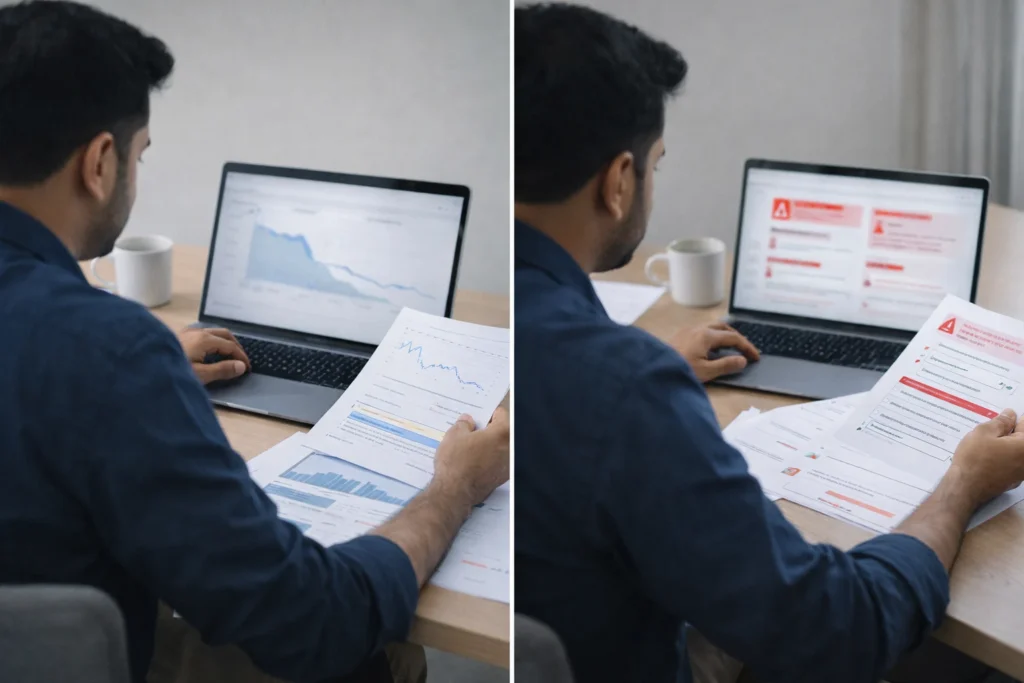
Broad ranking movement usually means content lost comparative strength, while spam trouble usually points to policy-violating patterns that need deeper cleanup.
A core update issue often looks like this:
- pages remain indexed
- no manual action appears
- rankings shift across many queries
- competitors with better content move ahead
A spam issue often involves patterns such as:
- scaled low-value pages
- expired domain abuse
- site reputation abuse
- doorway-style pages
- keyword stuffing
- manipulative redirects or hidden content
If your site used aggressive SEO shortcuts, do not assume this is only a broad google latest search algorithm re-ranking. Review your setup honestly, and compare it against Google’s official spam policies for Search.
What this update really means
The winners in 2026 will not be the loudest publishers; they will be the clearest, most credible, and most useful sources inside a tightly defined topic area.
Too many brands still treat SEO like a volume game. Publish more pages, repeat close variants, and hope one lands. That model keeps breaking because Google keeps getting better at comparing sameness.
For Indian businesses, the stronger model is simpler: fewer but stronger pages, real subject ownership, original insight from client work or market experience, local examples, better entity signals, and content clear enough to be quoted by AI systems. If your page is not easy to summarise, it is usually not strong enough to dominate search either.
How to future-proof against the next google latest algorithm change
You do not future-proof by chasing rumours; you future-proof by building pages that stay useful even when ranking systems get stricter.
Use this checklist:
- Put the answer in the first 100 to 150 words.
- Add clear author or reviewer information where readers expect it.
- Replace generic claims with examples, numbers, screenshots, or process details.
- Keep each page tightly aligned to one main intent.
- Refresh outdated pages instead of flooding the site with duplicates.
- Use relevant schema where it genuinely fits, such as Article, FAQ, Organisation, or Local Business. If your team is unclear on implementation, this guide on schema markup is a practical starting point.
- Make the page easy to scan, quote, and trust.
If you do this well, you are not just responding to what is the new google update. You are building content that is harder to displace in the next one.
Ready to grow after the update?
If your rankings dropped, do not guess. Let Digirank audit what changed, identify the pages losing qualified traffic, and turn your SEO into a measurable growth channel built for search, AI discovery, leads, and conversions. If you want stronger visibility, better-fit traffic, and a plan tied to ROI, this is the right time to act.
FAQs About the Google March 2026 Core Update
1. What is the Google March 2026 core update?
The Google March 2026 core update is a broad ranking update that began on March 27, 2026. It reassesses which pages best satisfy search intent across Google Search.
2. Is the March 2026 core update still rolling out?
As of April 1, 2026, it appears to still be rolling out. Google said the rollout may take up to two weeks, so rankings can keep moving until it settles.
3. Is the March 2026 core update the same as the spam update?
No. The spam update and the core update are separate. The spam update targets policy-violating practices, while a core update broadly reorders rankings based on relevance and usefulness.
4. Why did my traffic drop after the Google new update?
A drop usually means Google now sees other pages as more helpful for those queries. It does not automatically mean your site was penalised.
5. Did Google ban AI content in this update?
No. Google has not banned AI-assisted content. The risk is low-value content created mainly to manipulate rankings, especially at scale.
6. How long does recovery usually take after a google algo update?
It depends on how much needs fixing. Small gains can happen sooner, but stronger recoveries often appear after Google reassesses improved pages in later updates.
7. Should I rewrite my whole site during the rollout?
No. Wait for the rollout to settle, then review page-level losses and improve the pages that matter most. Panic edits usually create more noise than progress.
8. Does this Google update affect Google Ads too?
Not directly. This is a Search ranking update, not a Google Ads product update. However, organic shifts can still change SERP layouts, click patterns, and landing-page expectations.