
What Is Keyword Intent in SEO? A Clear Guide to Search Intent
Search intent in SEO means the real reason behind a search. In simple terms, keyword intent tells you what a person wants to do when they type a query into Google. They may want to learn something, compare options, visit a specific site, or take action now. If your page does not match that goal, rankings usually suffer even when the keyword appears in the title, headings, and copy.
Table of Contents
This is why keyword research alone is not enough anymore. Good SEO starts with understanding the searcher’s purpose and then building the right page for that purpose, which sits at the heart of what SEO really means. A blog works for an informational query. A pricing page works better for a transactional query. A comparison page works better for commercial research. When content matches intent, users stay longer, engage more, and move closer to conversion.
For startup founders, marketers, and business owners in India, this matters because the wrong content attracts the wrong traffic. The right intent match brings better rankings, stronger leads, and more useful visits from both search engines and AI answer platforms.
Why keyword intent matters more than just keyword volume
High traffic means little if the page solves the wrong problem for the searcher.
Many businesses chase keywords with big search volume and ignore what users actually want. That creates a common SEO mistake: a page ranks for impressions but does not earn clicks, trust, or leads. If someone searches best CRM for small business, they usually want comparison content, not a broad definition of CRM. If they search buy CRM software, they are much closer to action and expect a product or pricing page.
This is also how Google tends to evaluate relevance in practice, in line with Google’s guidance on creating helpful, reliable, people-first content. Search results often reveal the dominant intent clearly through the kind of pages ranking on page one. If you see listicles, comparison pages, and reviews, Google is signaling commercial investigation. If you see product pages, local pages, and sign-up pages, the query likely has transactional intent. If you ignore that pattern, the page will struggle, even if your on-page SEO looks technically correct.
The 4 main types of search intent in SEO

Most keyword intent falls into four simple buckets, and each one needs a different content format.
Informational intent
The user wants to learn, understand, or solve a problem.
These searches often begin with what, how, why, when, guide, tips, or examples. Queries like what is search intent or how to do local SEO sit here. The best format is usually a blog post, guide, explainer, checklist, or tutorial.
Navigational intent
The user already knows the brand, website, or destination they want.
Queries such as Digirank blog, Semrush login, or Google Search Console are navigational. In these cases, users want the exact page fast. Your homepage, service page, login page, or brand page should make that easy.
Commercial intent
The user wants to compare options before making a decision.
These searches often use words like best, top, review, compare, alternative, or vs. Someone searching best SEO agency in Bangalore or Ahrefs vs Semrush is not ready for a general awareness article. They want proof, comparisons, use cases, pricing direction, and decision support.
Transactional intent
The user is ready to act, subscribe, book, buy, or contact.
These searches often contain words like buy, hire, book, pricing, near me, quote, or demo. A person searching hire SEO agency in Bangalore is much closer to conversion than someone searching what is SEO. Transactional queries need landing pages, service pages, pricing pages, lead forms, call buttons, and trust signals.
How to identify keyword search intent the right way

The fastest way to find keyword search intent is to study the live search results, not just the keyword itself.
Start by searching your target query in Google. Then look at the first page closely.
Check what kind of pages rank
If blog posts dominate, the query is usually informational. If you see product pages or category pages, it is likely transactional. If listicles, reviews, and comparison pages rank, the query is usually commercial.
Look at the words inside the query
Modifiers help, but they are not perfect on their own. Words like how, guide, meaning, and tips often signal informational intent. Best, top, compare, and review often signal commercial intent. Buy, price, service, and near me often signal transactional intent.
Watch for SERP features
SERP features often reveal what Google thinks users want, and insights from the best SEO tools can make that analysis much faster. Google’s own explanation of how Search works also helps explain why result types and layouts matter. Featured snippets, People Also Ask, and video results usually show learning intent. Local packs often show local service or purchase intent. Shopping results and product grids often point to strong transactional intent.
Study title tags and angles on page one
The ranking pages tell you what format and promise Google prefers. Both Semrush’s guide to keyword intent and Ahrefs’ guide to search intent in SEO are useful references for spotting these patterns faster. If most top results say complete guide, beginner guide, or examples, then a thin opinion piece will probably not win. If most ranking pages offer comparisons and pricing, an awareness article will feel out of place.
A practical framework to match content with keyword intent
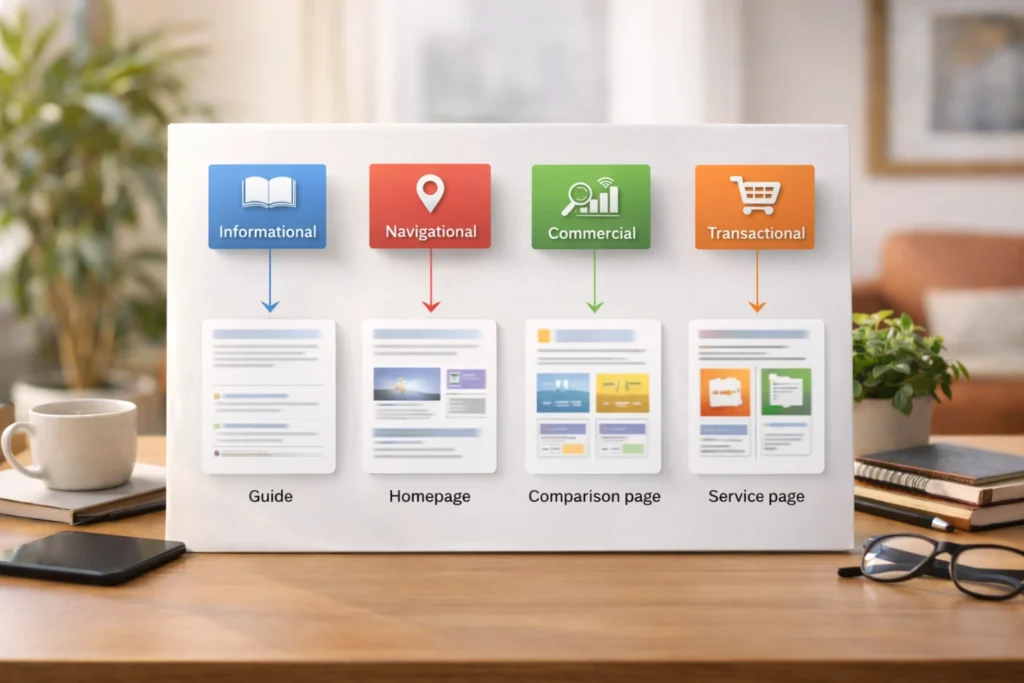
Once you know the intent, build the page format around it, not the other way around.
Here is a simple working model teams can use:
|
Intent type |
What the user wants |
Best page format |
|---|---|---|
|
Informational |
Learn or solve a problem |
Blog, guide, tutorial, checklist |
|
Navigational |
Reach a specific site or page |
Homepage, brand page, login page |
|
Commercial |
Compare options before choosing |
Comparison page, listicle, case study, review |
|
Transactional |
Take action now |
Service page, pricing page, product page, booking page |
This table matters because many SEO teams make one page type do every job. That rarely works. A blog post can support demand generation. A landing page can capture demand. A comparison page can bridge the gap between the two.
Signs your content does not match search intent
Poor rankings are not always a keyword problem. Often, they are an intent mismatch problem.
Here are the signals to watch:
- High impressions but low click-through rate
- Good traffic but short time on page
- High bounce or quick return to search
- Rankings stuck on page two or three
- Traffic that does not convert
- Users landing on a blog when they need a service page
This usually means your page answers a different question than the one the user came with. For example, if the keyword has commercial intent but your article stays educational, users may leave to find comparison content elsewhere.
How to optimise pages for search intent and AI answers
To win in modern SEO, your content must satisfy humans, search engines, and AI retrieval systems together. That is why it helps to understand both AEO and AI Overview optimisation.
Start each page with the direct answer. Then expand with examples, use cases, proof, and next steps. This works well for featured snippets, AI summaries, and voice-style queries because the response is easy to extract.
Use headings that mirror real questions. Add short definition blocks, practical examples, comparison points, and FAQ-style subtopics. For service pages, place proof near the top: outcomes, case examples, testimonials, pricing guidance, or process steps. For educational pages, explain clearly and move into action.
Also make the next step match the user journey. An informational article should not force a hard sales pitch too early. A transactional page should not bury the contact form under 1,500 words of theory.
Why Keyword Intent Matters for Business Growth
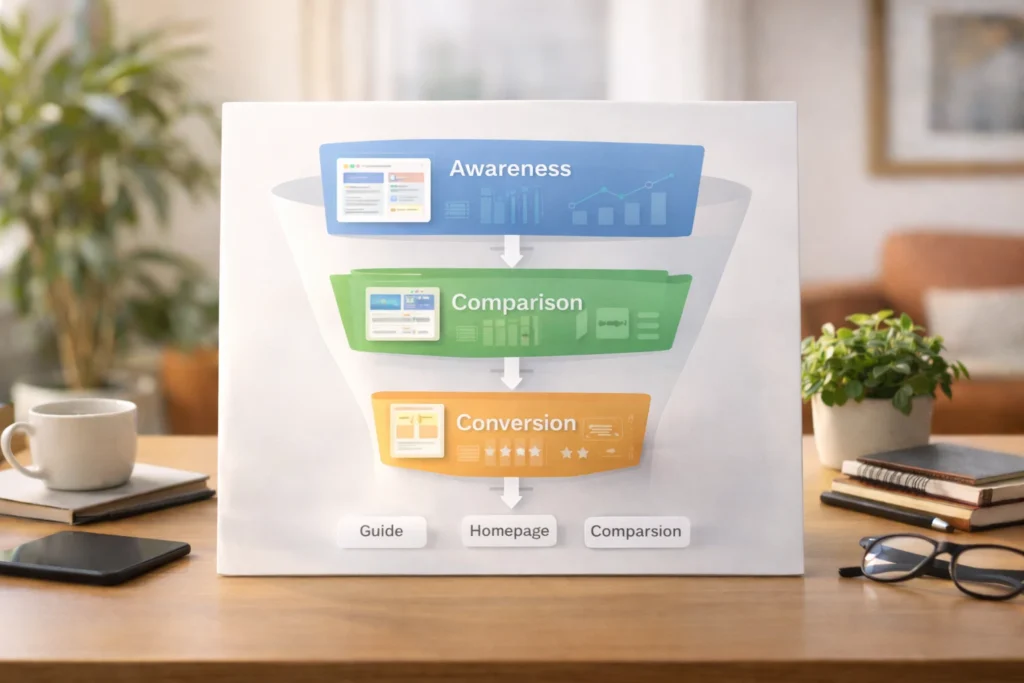
The biggest SEO mistake businesses make is treating keywords like traffic targets instead of customer signals.
At Digirank, the smarter view is this: every search query reflects a stage in the buying journey. A clear monthly SEO plan helps turn that insight into steady execution. Informational keywords build trust. Commercial keywords build preference. Transactional keywords capture demand. When you map content this way, SEO stops being a publishing task and starts becoming a growth system.
That shift matters even more now because AI platforms often reward pages that answer cleanly, structure ideas well, and show clear relevance. Google has also published guidance on succeeding in AI search experiences, which reinforces the value of useful, original content. If your content is vague, bloated, or mismatched to intent, it becomes harder to rank and harder to get cited.
Common mistakes people make with search intent
Most pages underperform because they optimise the keyword but ignore the expectation behind it.
A few mistakes show up again and again:
1. Writing one article for mixed intent keywords
Some keywords carry mixed intent, especially broad head terms. In that case, one page may not be enough. You may need a blog for awareness and a service page for conversion.
2. Copying competitor headings without improving clarity
Ranking pages show intent, but they should not become your template. Use SERP research to understand the user goal, then write something clearer, more useful, and more specific.
3. Ignoring local intent in India
Queries with city names, near me phrases, or service terms often need local landing pages, Google Business Profile support, reviews, and local proof. A generic national page may not satisfy that intent well.
4. Looking only at search volume
A lower-volume keyword with strong commercial or transactional intent often drives better ROI than a high-volume informational keyword.
What is search intent in SEO, really?
Search intent is simply the purpose behind a search, but in SEO it works like a relevance filter.
Google tries to rank pages that best match what users want to do next. That is why keyword intent sits at the core of modern content strategy, alongside the fundamentals covered in Google’s SEO Starter Guide. It shapes your page type, headline angle, content depth, CTA, internal links, and conversion path.
Once you understand that, keyword research becomes much more useful. You stop asking which keyword has the most volume and start asking what problem this user is trying to solve right now. That is the question that usually leads to better rankings and better business outcomes.
Ready to turn search intent into qualified leads?
If your site gets traffic but not enough leads, the problem may not be visibility alone. It may be intent mismatch. Digirank helps businesses build SEO and content systems that attract the right audience, improve search visibility, and convert high-intent visits into measurable growth through SEO services in Bangalore and strategy built around real search behaviour. If you want pages that rank with purpose and drive ROI, now is the time to fix the gap between what people search and what your site delivers.
Frequently Asked Questions about Keyword Intent
1. What is keyword intent in SEO?
Keyword intent in SEO is the reason a person searches for a word or phrase. It helps you understand whether they want information, a comparison, a specific website, or an action like buying or contacting.
2. What is search intent and why does it matter?
Search intent is the purpose behind a query. It matters because Google tries to rank pages that match that purpose. When your content fits the user goal, you usually get better engagement, stronger rankings, and more useful traffic.
3. How do I find keyword search intent?
The best way is to search the keyword in Google and study page one. Look at the type of pages ranking, the titles, the SERP features, and the wording of the query. Together, they usually show the dominant intent.
4. What are the four types of search intent?
The four main types are informational, navigational, commercial, and transactional. Informational means learning. Navigational means finding a known site. Commercial means comparing choices. Transactional means taking action.
5. Can one keyword have more than one intent?
Yes. Some broad keywords show mixed intent. In those cases, Google may rank different page types together. You may need separate pages for awareness and conversion instead of forcing one page to do both jobs.
6. Is keyword intent more important than search volume?
For business results, it often is. A keyword with lower volume but stronger buying intent can bring better leads and better ROI than a broad keyword with much higher traffic.
7. How does keyword intent help with AI Overviews and voice search?
Intent-focused pages work better because they answer clearly, use structured headings, and solve a specific question fast. That makes them easier for AI systems and voice assistants to extract and cite.
8. How often should I review search intent for a keyword?
Review it regularly, especially when rankings drop or the SERP changes. Search intent can shift over time as Google updates results or as user behavior changes.